
Last Updated on August 7, 2026 by Ashley Vasta
Quick Answer: The three foundational dog agility commands are table (hold a stay on a raised platform), over (jump a raised obstacle), and under (crawl beneath an obstacle). Practicing these agility commands regularly gives your dog a job to focus on and can reduce stress, anxiety, and reactive behavior.
Does your dog jump up on the patio picnic table or launch onto your living room couch the second you turn your back? If so, dog agility training might be exactly what your dog’s future needs.
Beyond the ribbons and courses you see in competition, dog agility gives everyday pet dogs a job to do and an outlet to work through stress, dog anxiety, and reactive or aggressive tendencies. By practicing these agility obstacle exercises a few minutes a day, most owners notice calmer, more controllable behavior within just a few weeks.
What Does the Research Say About Agility and Stress?
A 2026 study in the Journal of Applied Animal Welfare Science measured saliva cortisol in dogs before, during, and after agility training sessions. Beginner dogs showed more stress-related behaviors, like panting and licking, while dogs with more training experience showed a different behavior pattern. This suggests that coping skills develop with guided practice over time (Macchi et al., 2026).
The American Kennel Club echoes this, noting that the focus, trust, and self-control agility requires on the course often carries over into calmer behavior off the course, too. That is why I recommend it so often for the anxious and reactive dogs I train throughout Chandler and the greater Phoenix area.
1. Table. The table obstacle is a 3ft. by 3ft. platform where the dog will do a down/stay command for up to 5 seconds, then gradually longer. This hold time will provide focus and added control so the dog becomes more conditioned for calmness and stress reduction.
I teach my customers with high prey-driven dogs or mildly reactive dogs to use the table command as a distraction technique for any oncoming potential trigger, i.e. dogs, bikes, or skateboards. Begin looking for obstacles on your walk you can use for the table command, i.e.,agili picnic tables, large rocks, or park benches around Chandler and Gilbert.
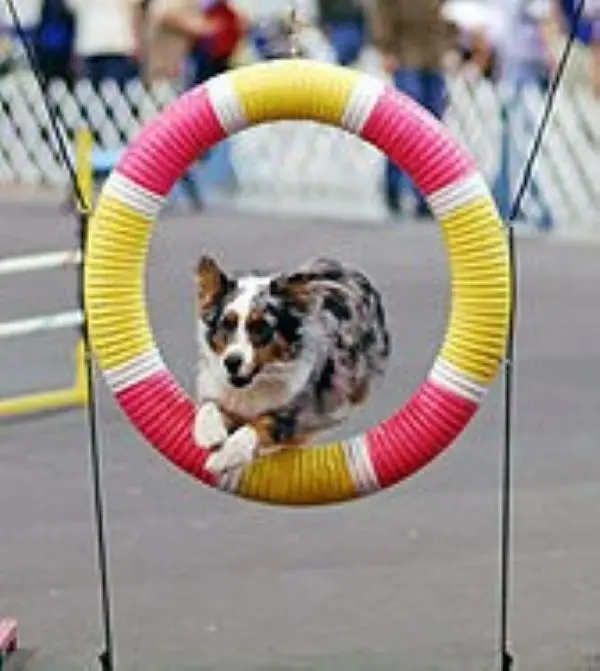
2. Over. The over obstacle can be used with either a single or multiple raised obstacles. The appropriate height will be determined by the athleticism and energy of your dog, not just their size. Of course, never judge a dog by its cover! Certain breeds like Jack Russell Terriers have been known to jump upwards of 6ft. Begin looking for obstacles on your walk you can use for the over command, i.e., parking curbs, picnic table benches, or fallen logs.
3. Under. The under command can be used to have your dog go under an obstacle such as a picnic table bench, a low sign, or any small enclosed area. The benefit of the under command is decreased anxiety and claustrophobia in small spaces. The under command is most beneficial to smaller, prey-driven dogs.
Training Tips for Getting Started Safely
Start with the lowest, easiest version of each obstacle and use positive reinforcement, such as treats or praise, the moment your dog succeeds. I outline this reward-based approach in more detail in my article on dog training reward methods.
Keep sessions short; five to ten minutes is plenty, and always end on a win. If your dog reacts strongly to other dogs, people, or fast movement, work with a professional trainer before attempting agility obstacles in public spaces like dog parks or busy trailheads.
Frequently Asked Questions
What are the 3 basic dog agility commands?
The three basic dog agility commands are table (stay on a platform), over (jump an obstacle), and under (crawl beneath an obstacle). Together they build focus, confidence, and calmness.
Can dog agility training help with anxiety or aggression?
Yes, in many cases. Agility gives a dog a job to focus on instead of a trigger, and research shows dogs with more agility experience display different, often calmer, stress responses than beginners. Dogs with significant anxiety or aggression should start under the guidance of a professional trainer.
How do I start agility training my dog at home?
Use safe household or outdoor items, such as a sturdy bench for the table command, a low curb for over, and a picnic table for under, and reward every success with treats or praise. Keep sessions short and end on a positive note.
Where can I find professional dog agility training near me?
Doggie Steps Dog Training provides in-home dog agility and obedience training throughout Chandler, Phoenix, Scottsdale, Mesa, Gilbert, Tempe, and the rest of the East Valley, Arizona area.
By routinely practicing these 3 agility commands you will see great dog training results from your dog. Not only will your dog develop increased focus and attention span, but through the use of agility, a greater mental and physical challenge as well.
Happy dog training!
Ready for hands-on help? Contact Doggie Steps Dog Training to schedule in-home dog agility and obedience training in Chandler, AZ and throughout the greater Phoenix East Valley.
